Published By
Anonymous
Created On
14 Aug 2023 20:31:05 UTC
Transaction ID
Cost
Safe for Work
Free
Yes
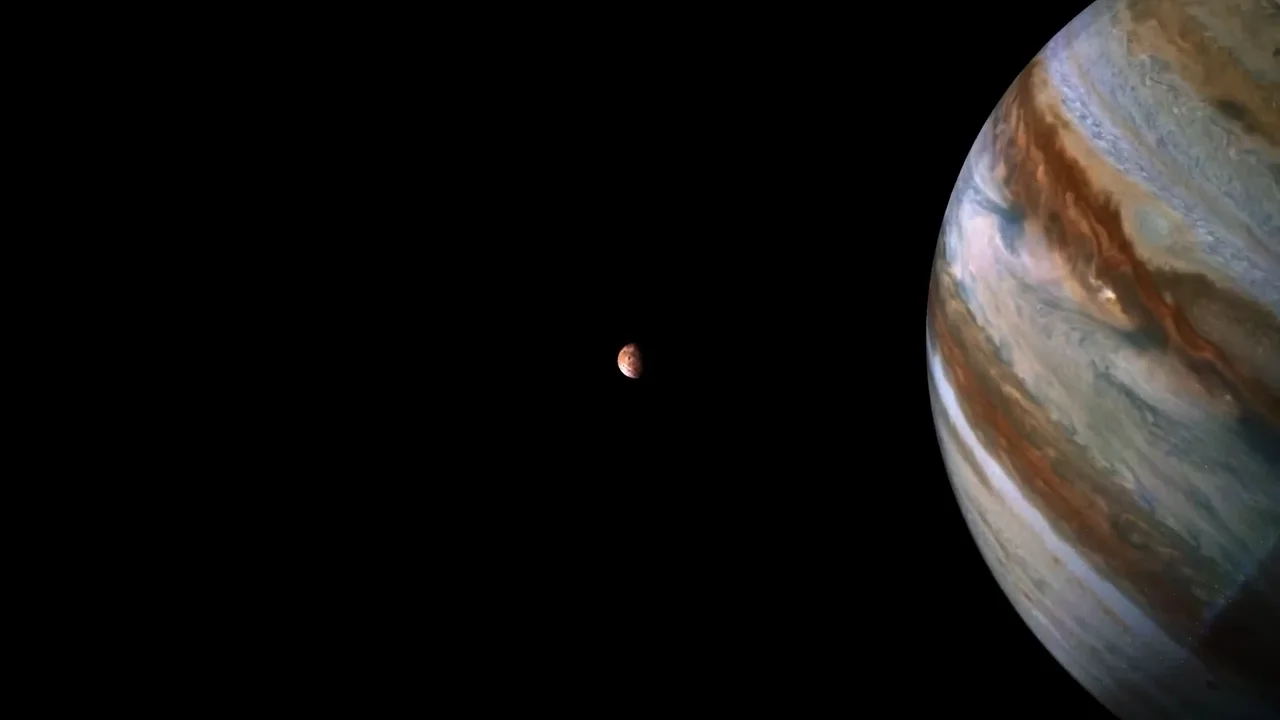
NASA's Spacecraft Ventures Past Io and Jupiter, Unveiling
In a spectacular display of human ingenuity and scientific curiosity, NASA's Juno spacecraft recently embarked on a mesmerizing journey through the intricate dance of Jupiter's moons, culminating in a breathtaking flyby of the enigmatic moon Io. This remarkable mission marks another chapter in humanity's quest to unravel the mysteries of our solar system and gain deeper insights into the origins and evolution of these distant celestial bodies.<br /><br />Juno, a cutting-edge spacecraft equipped with a suite of advanced instruments, was launched by NASA on August 5, 2011, with the primary goal of studying Jupiter's atmosphere, magnetosphere, and interior structure. After a five-year journey covering a staggering distance of nearly 2.8 billion kilometers (1.7 billion miles), Juno finally entered Jupiter's orbit on July 4, 2016. Since then, it has been on a series of highly elliptical orbits, swooping close to the gas giant's cloud tops to gather unprecedented data and images.<br /><br />On a crisp morning in late July of this year, Juno embarked on a momentous mission to explore the captivating moon Io, which is known for its vibrant hues, violent volcanic activity, and enigmatic surface features. Io, the fourth-largest moon of Jupiter, is an otherworldly landscape characterized by its stark contrasts - from its vivid sulfur-yellow plains to the dark, crater-covered regions, giving it a surreal appearance reminiscent of an artist's palette.<br /><br />The spacecraft's journey to Io was not only a triumph of precise orbital mechanics but also a testament to the collaborative efforts of scientists, engineers, and mission planners. Juno's trajectory was meticulously calculated to ensure a close yet safe encounter with Io, allowing the spacecraft's instruments to capture high-resolution images, study its volcanic eruptions, and investigate the moon's magnetic field.<br /><br />As Juno approached Io, its cameras and spectrometers came to life, capturing images that transported scientists and space enthusiasts alike into the heart of this distant moon's geological drama. The spacecraft's instruments observed plumes of volcanic material erupting from Io's surface, creating an ethereal scene against the backdrop of the giant gas giant Jupiter. These plumes, consisting of sulfur and other compounds, rise high above Io's surface, further adding to its mystique.<br /><br />The flyby wasn't solely focused on Io; Juno's scientific instruments also took advantage of the proximity to Jupiter. As the spacecraft looped around the planet, it delved into the study of Jupiter's powerful magnetic field and vast auroras, shedding light on the complex interactions between the gas giant and its surrounding environment.<br /><br />The images and data collected during Juno's journey past Io and Jupiter have ignited a fervor of excitement among scientists and space enthusiasts alike. These new insights will undoubtedly fuel countless research papers, discussions, and discoveries as researchers dive into the intricacies of Io's geological activity, its interaction with Jupiter's magnetic field, and the broader dynamics of the Jupiter system.<br /><br />As we marvel at the images and findings from Juno's latest adventure, we are reminded of the indomitable human spirit that drives us to explore the cosmos. The mission stands as a testament to the remarkable achievements of space exploration and the boundless curiosity that propels us to uncover the secrets of our universe. With each orbit, flyby, and data transmission, Juno brings us one step closer to unraveling the enigmas of Io, Jupiter, and the celestial tapestry that surrounds them.<br /><br /><br />#JunoMission<br />#JupiterExploration<br />#IoFlyby<br />#NASA<br />#SpaceScience<br />#CelestialExploration<br />#Astronomy<br />#SpaceDiscoveries<br />#JunoSpacecraft<br />#GasGiant<br />#MoonsOfJupiter<br />#SpaceOdyssey<br />#PlanetaryMysteries<br />#CosmicWonders<br />#SpaceAdventures<br />#JunoAtIo<br />#JupiterSystem<br />#SolarSystemWonders<br />#AstronomicalDiscoveries<br />#IoVolcanoes<br />#InterplanetaryJourney<br />#SpaceResearch<br />#GalacticExploration<br />#JunoAndJupiter<br />#SpaceProbe<br />#ExtraterrestrialWorlds<br />#Astrophysics<br />#JunoFlyby<br />#JupiterMoons<br />#SpaceMissionSuccess<br /><br /><br />Juno spacecraft<br />Io moon<br />Jupiter flyby<br />NASA mission<br />Space exploration<br />Gas giant planet<br />Celestial bodies<br />Planetary system<br />Scientific discovery<br />Astronomical data<br />Space technology<br />Volcanic activity<br />Cosmic mysteries<br />Interplanetary research<br />Space mission highlights<br />Atmospheric studies<br />Magnetic field observations<br />Lunar terrain<br />Solar system exploration<br />Planetary geology<br />Sulfur plumes<br />Space photography<br />Planetary dynamics<br />Spaceprobe insights<br />Extraterrestrial phenomena<br />Galactic phenomena<br />Astrophysical insights<br />Solar system wonders<br />Cosmic interactions<br />Space mission achievements
Author
Content Type
Unspecified
video/mp4
Language
English
Open in LBRY