LBRY Block Explorer

LBRY Claims • Transistorized

c2281633566a7c53525297dbb37b6f5e63bf3bb6

Published By
Anonymous
Created On
14 Nov 2021 23:02:02 UTC
Transaction ID
Cost
Safe for Work
Free
Yes
Transistorized! - History of the Transistor
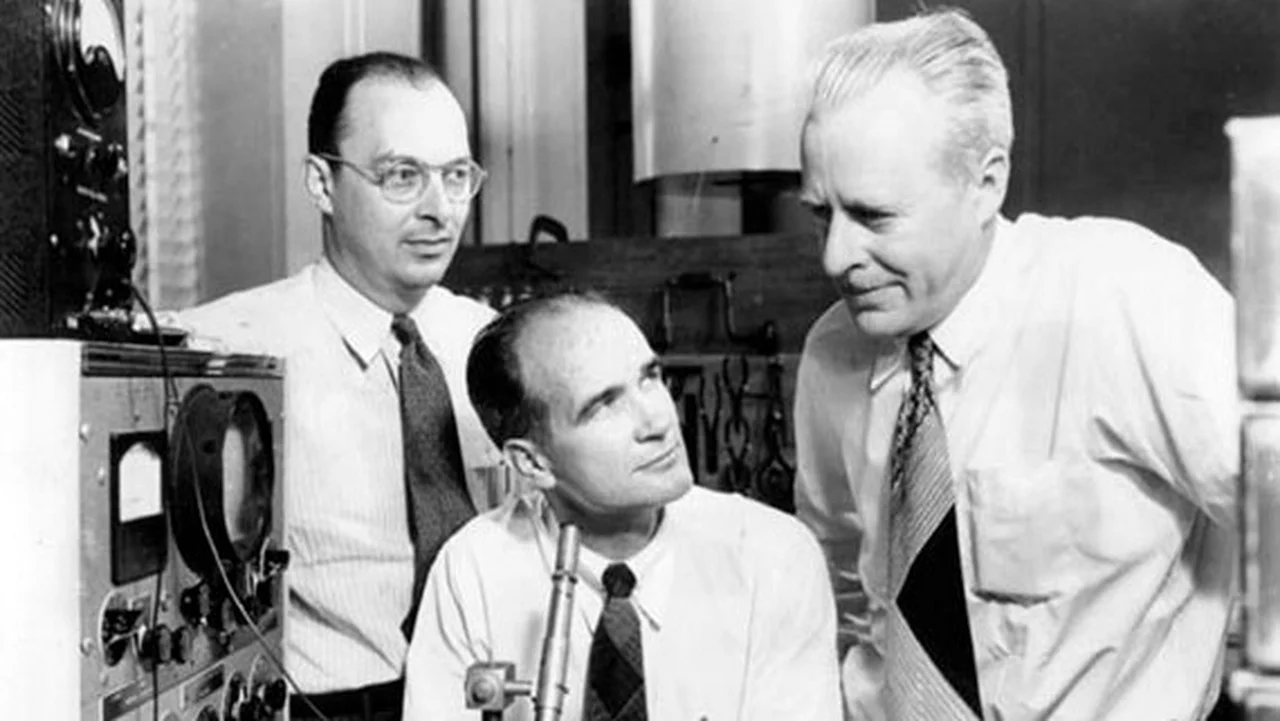
The story behind the creation of the transistor, one of the 20th century's most important inventions..<br /><br />Released in: 1999<br />Hosted by: Ira Flatow<br />Produced by: ScienCentral <a href="https://www.sciencentral.co" target="_blank" rel="nofollow">https://www.sciencentral.co</a><br />Broadcast by: PBS <a href="https://www.tpt.org/watch-live/" target="_blank" rel="nofollow">https://www.tpt.org/watch-live/</a><br /><br />Scientists in the 1920s proposed building amplifiers from semiconductors. But they didn’t understand the materials well enough to actually do it. In 1939, William Shockley at AT&T’s Bell Labs revived the idea as a way to replace vacuum tubes.<br />Under Shockley’s direction, John Bardeen and Walter Brattain went to work on the transistor. Their transistor consisted of a sliver of germanium with two closely spaced gold point contacts held in place by a plastic wedge. They selected germanium material that had been treated to contain an excess of electrons, called N-type. When they caused an electric current toflow through one contact (called the emitter) it induced a scarcity of electrons in a thin layer (changing it locally to P-type) near the germanium surface. This changed the amount of current that could flow through the collector contact. A small change in the current through the emitter caused a larger change in the collector current. They had created a current amplifier.<br /><br />In 1948, Shockley invented the more robust junction transistor, built in 1951.<br />The three shared the 1956 Nobel Prize in Physics for their inventions.<br /><br />AT&T, which had invented the transistor, licensed the technology in 1952. It hoped to benefit from others’ improvements.<br />Licensees of Bell Labs transistor technology developed alternative manufacturing techniques to improve the performance and reduce the cost of transistors. The germanium devices were optimized for particular applications.<br /><br />Transistors swiftly left the lab and entered the marketplace. Although costlier than vacuum tubes, they were ideal when portability and battery operation were important. The 1952 Sonotone hearing aid was America’s first transistorized consumer product. AT&T also used transistor amplifiers in its long distance telephone system. They soon appeared as switches, beginning with an experimental computer at Manchester University in 1953.<br /><br />**Switching to Silicon**<br />America’s high-tech home might have been “Germanium Valley” if named for the material in early transistors. Silicon offered better performance, but was too hard to work with.<br /><br />That changed in 1954. “Contrary to what my colleagues have told you about the bleak prospects for silicon transistors,” announced Texas Instruments’ Gordon Teal at a conference, “I happen to have a few of them here.” He then demonstrated a record player that failed when its germanium transistors were heated, but not with silicon transistors.<br /><br />By 1960, most transistors were silicon. TI was their leading manufacturer. <br />The silicon transistor’s ability to operate at temperatures up to 150°C made it an essential component in U.S. space and defense programs.<br /><br />As prices dropped, uses multiplied. By 1960, most new computers were transistorized.<br /><br />-----------------------<br /><br />There is no copyright infringement intended for the video and/or material used in this video. 'Copyright Disclaimer Under Section 107 of the Copyright Act 1976, allowance is made for 'fair use' for purposes such as criticism, comment, news reporting, teaching, scholarship, education and research. Fair use is a use permitted by copyright statute that might otherwise be infringing. Non-profit, educational or personal use tips the balance in favor of fair use' LEGAL DISCLAIMER The content within these recordings are property of their respective Designers, Writers, Creators, Owners, Organizations, Companies and Producers.
Author
Content Type
Unspecified
video/mp4
Language
English
Open in LBRY